

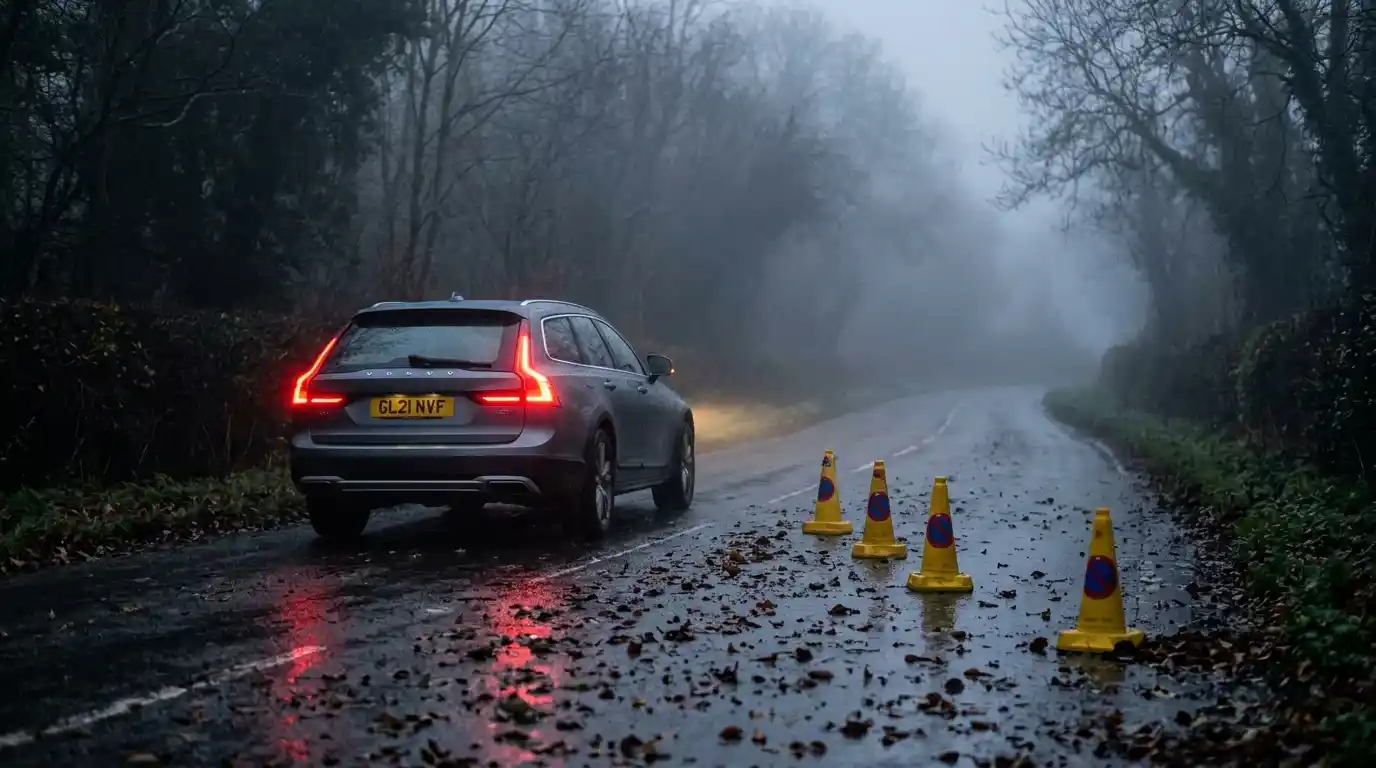
A five-minute journey might become the longest five minutes of your week due to fog. The car in front of you disappears into a grey wall one moment, then the road ahead is perfectly visible the next. At Pharez Driving School, where I have instructed hundreds of students, fog is the one situation that causes even self-assured drivers to tighten their hold on the wheel.
In summary, you should slow down, use dipped headlights, increase your distance from the car in front of you, and remain prepared to stop when driving in fog. I’ll explain the significance of each step, what the Highway Code actually states, and the common mistakes made by drivers. By the time it’s all over, you’ll know exactly what to do the next time fog suddenly appears.
Why Fog Forms and Why It Catches Drivers Out
When warm, humid air collides with a chilly surface, water vapour condenses into small droplets that are hung close to the ground, creating fog. It is particularly common in damp evenings, valleys, and regions close to rivers or lakes; for this reason, some routes appear to experience fog every week, while others do not.
How quickly it changes is the difficult part. It just takes a few seconds to transition from a clear stretch of road to dense fog, particularly on country roads or in areas with steep topography. Reacting early is more important than reacting quickly because of this abrupt change.
Instead of only serving as a warning, a brief figure from the UK Department for Transport’s road casualty reports that illustrates the annual number of incidents caused by fog or mist will give readers a true sense of the danger.
How to Drive Safely in the Fog
Fog is more than simply a nuisance. It obscures dangers until they are directly in front of you, reduces your visibility, and decreases your reaction time. You should approach driving in fog as an entirely distinct scenario rather than just “normal driving but slower.”
Your eyes use distance to determine space and speed. That point of reference is eliminated by fog. Your normal sense of timing becomes unreliable when a car that appears far away is only a few seconds away from your bumper.
Slow down before you need to, not after. Ease off the accelerator as soon as you notice visibility dropping. Waiting until you’re deep in a fog bank to react gives you far less room for error.
Match your speed to what you can actually see, not to the speed limit or the flow of traffic. If you can only see 50 metres ahead, you need to be able to stop within that distance. Ignore anyone tailgating you. Their impatience isn’t your problem to solve.
What Light Settings Should You Use in Fog?
You should use dipped-beam headlights alongside front and rear fog lights when visibility drops below 100 metres (328 feet). Never use full-beam headlights in foggy conditions, as the water droplets reflect light straight back into your eyes.
Dipped beams project light downward onto the road surface, illuminating lane markings without bouncing glare into your line of sight.
The Automatic Lights and DRL Trap
Modern vehicles often feature automatic lighting sensors and Daytime Running Lights (DRLs). These system designs often fail in foggy weather.
Light sensors detect ambient brightness rather than horizontal air clarity. As a result, your car might leave headlights disabled during bright daytime fog, leaving rear lights completely unlit.
Step-by-Step Precautions When Entering a Fog Bank
1. Check Mirrors and Reduce Speed
Before slowing down, check your rear-view mirror to assess trailing traffic. Tap your brake pedal lightly to illuminate brake lights and signal drivers behind before applying firm braking pressure.
2. Expand Your Following Distance
When driving in a fog you should adjust your following distance to at least double the standard two-second gap. A four-second gap provides ample reaction time if cars ahead stop unexpectedly.
3. Clear Condensation and Listen at Junctions
Fog creates moisture on windshield glass. Keep wipers active and run front and rear demisters continuously.
At blind crossroads, wind down side windows slightly. Listening for engine sounds compensates for reduced visual feedback.
What Does the Fog Light Symbol Look Like?

The front fog light sign often depicts a lamp pointing to the left with light beams travelling along a wavy, vertical line. The sign for the rear fog light indicates the opposite way. Each car has a different exact dashboard design, so if you’re not sure which switch controls each light, consult the owner’s manual.
Front fog light symbol
The front fog light symbol generally points to the left. Its light lines pass through a wavy vertical line.
Rear fog light symbol
The rear fog light symbol generally points in the opposite direction, with horizontal light lines crossing the wavy line.
When Should I Use My Fog Lights?
Only when visibility is less than 100 meters, or around the length of a football pitch, should you use your fog lights. Highway Code Rule 226, which stipulates that you must turn them off whenever visibility improves because they can dazzle other vehicles, is the source of this threshold.
One easy trick I teach my students is that you probably don’t need your fog lights yet if you can still see the car’s tail lights in front of you. It’s time to turn them on when that car begins to blur or vanish.
As soon as the fog clears, you should always turn off your fog lights when driving. It’s not only poor manners to leave them on in clear weather. You may be fined under the Road Vehicles Lighting Regulations of 1989, and your insurance claim may be impacted if you are involved in an accident while your fog lights are on needlessly.
Cars registered in the UK are legally required to have rear fog lights fitted. Front fog lights aren’t a legal requirement, though many vehicles come with them as standard.
Fog and Your Driving Test
Foggy situations are taken seriously by examiners, and for good cause. Your instructor and examiner will expect you to exhibit the precise habits discussed above, not merely regurgitate them, if you’re a learner and fog rolls in on test day.
When conditions change, DVSA examiners check for seamless speed reduction, appropriate light use, and reasonable following distance. Driving cautiously slow is much less detrimental than panicking or freezing behind the wheel.
Fog is also a common talking point during the theory test, particularly around stopping distances and the correct use of lights. Understanding the reasoning behind each step, not just memorising it, tends to stick with learners far longer once they’re driving independently.
My advice to every learner at Pharez Driving School: practise in mild fog or drizzle before your test if you get the chance. It builds the muscle memory so you’re not thinking through each step for the first time under pressure.
When Fog Turns to Ice
Fog and cold temperatures are a dangerous pair. As fog settles on a cold road surface, that moisture can freeze into a thin, nearly invisible layer of ice, especially in the early morning or late evening.
Watch your temperature gauge if your car has one. Anything close to freezing alongside fog is a signal to ease off even further and avoid sharp steering or braking inputs.
Bridges, shaded stretches, and untreated back roads tend to freeze first. Treat these spots with extra caution any time fog and cold weather show up together.
When driving in a fog you should also check your local weather forecast the night before if you know an early start is coming. A quick look can tell you whether you’re dealing with mist that burns off by mid-morning or a thicker fog bank that’s set to linger for hours.
Summary Checklist for Driving in Fog
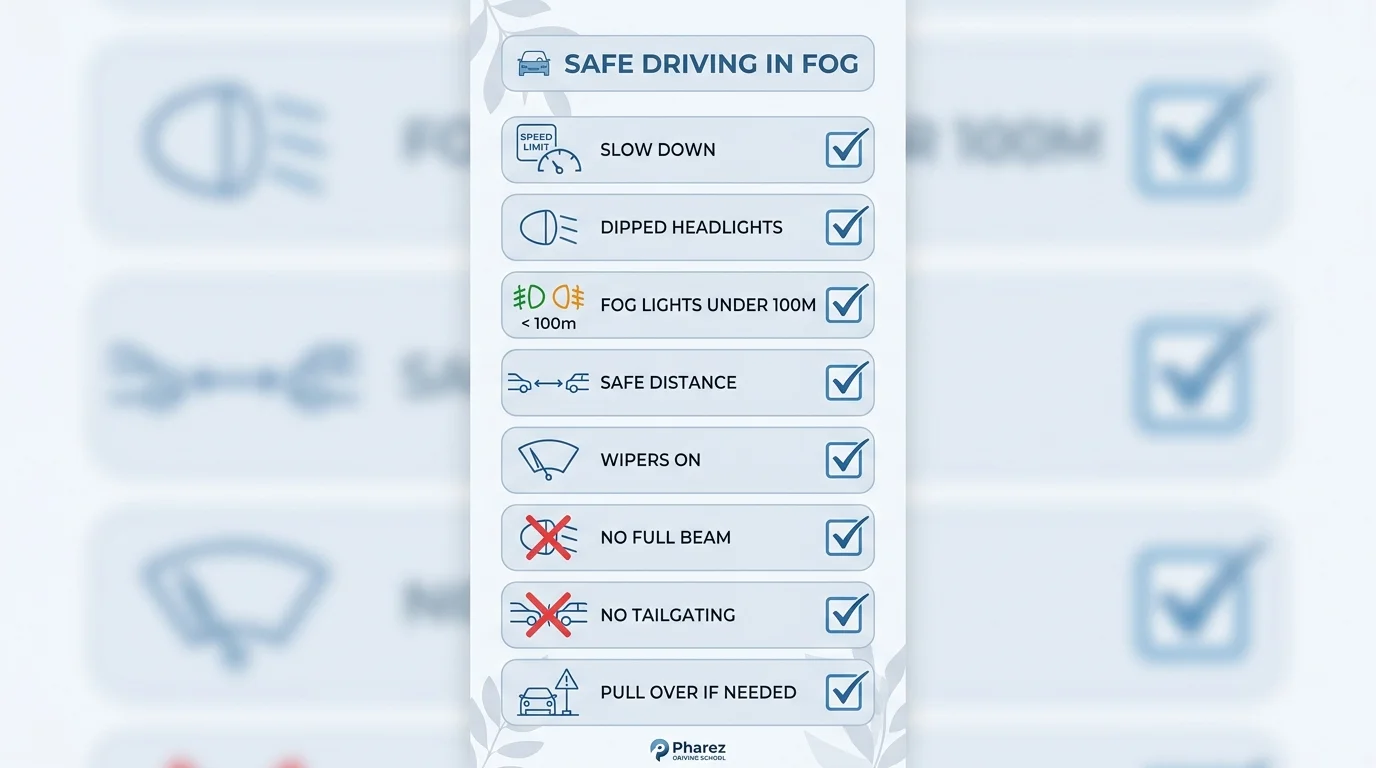
Here’s a quick-reference list covering the essentials, whether you’re a new driver or you’ve been on the road for decades.
- Slow down as soon as visibility drops
- Switch to dipped headlights immediately
- Add front or rear fog lights below 100 metres visibility
- Increase your following distance to four seconds or more
- Keep wipers and demisters running
- Avoid full beam at all times in fog
- Never follow another car’s tail lights as your guide
- Turn fog lights off once visibility improves
- Pull over safely if you genuinely can’t see the road
Common Mistakes Drivers Make in Fog
Latching onto Tail Lights: Following target cars closely gives a false sense of security. If the lead vehicle strays off course or brakes hard, you risk colliding with them.
Speeding Up in Clear Patches: Fog frequently drifts in uneven banks. Accelerating quickly when visibility clears momentarily leaves you vulnerable to sudden thick patches.
Using Cruise Control: Automatic speed systems delay manual pedal overrides on slick surfaces, increasing skid risks.
Ignoring Overhead Matrix Displays: Overhead motorway signals reading “FOG” warn of approaching hazards even if local air appears clear.
Pricing Packages
Reading about fog driving is useful, but nothing replaces supervised practice in real conditions with someone who knows what to look for. At Pharez Driving School, our lessons cover hazardous weather driving as part of a wider, structured course, so you’re not facing fog, rain, or ice for the first time on your own.
If you’d like to see what’s included and find a package that fits your schedule and budget, take a look at our pricing packages page. Every course is built around the kind of real-world situations you’ll actually meet on UK roads, fog included.
Final Thoughts
People are caught off guard by fog because it varies quickly and penalises hesitation. Follow the fundamentals: slow down, add distance, dip your lights, and don’t rely on your eyes to perceive speed as they typically would. You should never assume that fog will clear fast when driving, so instead of hoping for the best, plan your trip with that in mind.
Contact Pharez Driving School if you’re still developing your driving confidence or if you’d like guided practice in actual weather. We are pleased to respond to enquiries and assist you in creating a lesson plan that truly gets you ready for UK roads, fog, and everything.
FAQs
What should you do when driving into fog?
When driving into fog you should slow down, switch to dipped headlights, increase your following distance, and use your fog lights once visibility drops below 100 metres. Pull over safely if visibility becomes too poor to continue.
Is it illegal to drive with fog lights on when it’s not foggy?
Yes. Under the Road Vehicles Lighting Regulations 1989, using fog lights when visibility isn’t reduced can result in a fine, since the strong light can dazzle other drivers unnecessarily.
What speed should you drive at in fog?
There’s no fixed number, since it depends entirely on how far you can see. A safe rule is to drive slowly enough that you could stop well within the distance visible ahead of you.
How far should you stay behind the car in front in fog?
Extend your usual two-second following distance to at least four seconds. Reduced visibility means longer reaction times and longer stopping distances for everyone on the road.
Can fog lights be used at any time?
No. Fog lights should only be switched on when visibility drops below 100 metres, and switched off as soon as conditions improve, in line with Highway Code Rule 226.